



For generations, Hollister has been a proud, hardworking, “Friday night lights” kind of town. It’s a community rooted in legacy, where families span back five, six, or seven generations, and almost everyone shares the common bond of walking the halls of Hollister High School. But over the last four years, an exciting transformation has been taking place inside those historic halls.
Through a powerful partnership with the Central Coast K-16 Regional Collaborative, Hollister High School has utilized vital regional grant funding to supercharge its Academy of Health Science Career Technical Education (CTE) pathway. By strategically braiding these regional resources with funding from California’s Golden State Pathways Program, the school has created a sustainable, highly-resourced educational ecosystem that maximizes support for local students. The initiative is part of a broader mission by the Collaborative—which invested $9.8 million into regional career pathways in healthcare, engineering, and computer science—to dismantle long-standing educational and economic inequities. By bridging the gap between classroom curriculum and regional industries, this grant funding is helping local students secure high-wage, high-impact careers right in their own backyard.
A “School Within a School” Grounded in Equity
At Hollister High, the Academy of Health Science functions as a tight-knit, cohorted learning community. This structural “school within a school” design creates an immediate sense of belonging for its students, many of whom are first-generation and Latinx.
“Our job and my job as a leader is really to elevate, to lift, to promote the opportunities for our future generations,” says Dr. Shawn Tennenbaum, San Benito High School District Superintendent. “When you look at the Academy of Health Science, it is more than a pathway. It is an opportunity for our first-generation students…to be able to not only live in the community that their families have lived in for generations, but to be able to provide a sustainable home.”
Because students stay together in the same cohorts for most of their classes, they naturally form a strong, familial support system. As student Kylie Luna shared: “I’m kind of a shy person and I struggle with like meeting new people and communicating at times, but with the cohort like it feels like they’re my family… If somebody’s falling behind, we try to help each other pick it back up and get on the right track.”
The Magic Sauce: Linked Learning and Real-World Application
What makes Hollister’s program stand out is its commitment to “Linked Learning”—a method where academic curriculum completely intertwines with medical contexts. Thanks to the grant funding, the high school has successfully layered rigorous technical CTE instruction with personalized learning, Work-Based Learning and dual-enrollment college credits.
Educators at the academy call the Project-Based Learning component the “magic sauce.” For instance, a freshman’s English 9 class isn’t just traditional English; it’s taught entirely through the lens of mental and behavioral health. Students read literature focused on psychology and sociology while simultaneously taking an introductory medical terminology or healthcare careers course.
Every semester, these subjects collide in mandatory project-based learning assignments. Students recently completed public service announcements (PSAs) centered on the theme “Brain Health is Public Health.” Through this project, students earned online certifications regarding Alzheimer’s and the aging brain, and then created educational videos to teach fellow teenagers how to make smart lifestyle choices to protect their long-term brain health. The videos didn’t just stay in the classroom; they were shared directly with community spaces, benefiting the entire county.
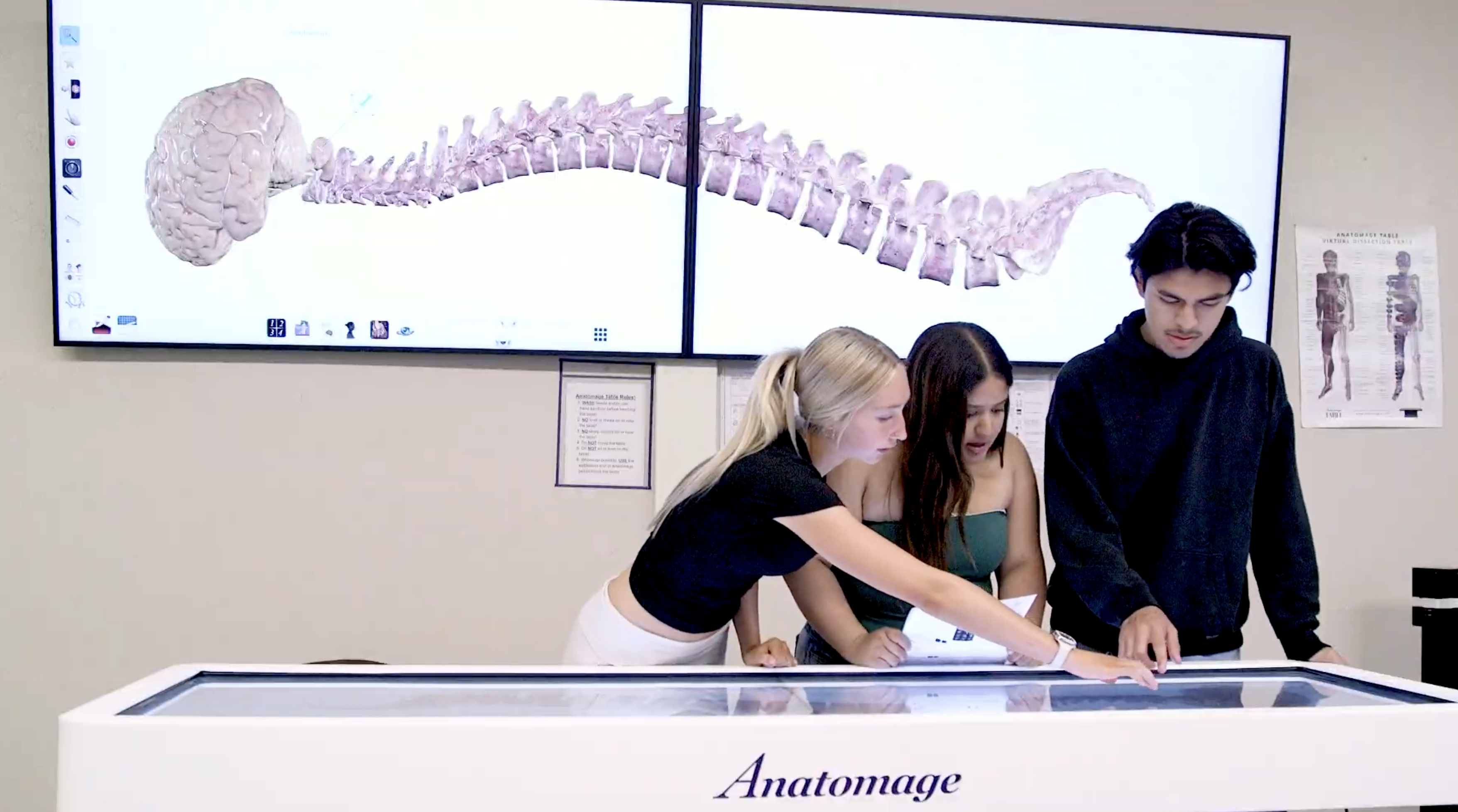
Hollister High School students work in class on a life-sized 3D anatomy visualization and virtual dissection table.
Hands-On Training and Career Realities
The Academy allows students to actively explore diverse facets of medicine, from nursing to athletic training and occupational therapy. Students complete extensive internships and clinical rotations, allowing them to figure out exactly where their passions lie.
Student Stephanie Paz, an aspiring nurse, reflected on the value of the program’s clinical placement: “I completed about 96 hours at the nursing facility. I was able to be with CNAs as well as other nurses. And I would love to pursue this career and become the next generation of nurses.”
For other students, the hands-on exposure has opened doors to specialized fields:
- Occupational Therapy: “I decided to go to occupational therapy because of my experience here and learning all the rehab… I like being next to a person, helping them, teaching them the exercise,” noted academy student Ixchel Torres.
- Trauma Surgery: Student Taylee Aguilar chose an internship in athletic training specifically because “a lot of what athletic training is is emergencies and trauma,” aligning perfectly with a lifelong dream of becoming a surgeon.
Whether students are preparing to enter a four-year university to become pediatricians, enlisting on a military route as an aerospace medic, or transitioning straight into the local workforce, the academy ensures every graduate is fully college and career ready to succeed the moment they step off the stage.
A Family and Community Affair
Hollister’s Academy of Health Science recognizes that building a sustainable pipeline into local healthcare requires more than just teachers and students—it takes an entire dedicated community. Parents, dedicated school counselors, and local industry partners form the core of the pathway’s ecosystem. They actively collaborate to support student success, whether it’s parents driving students to local health clinics, counselors keeping students on track for graduation and college requirements, or industry partners coming into the classroom as guest speakers and offering professional internships.
Ultimately, the Central Coast K-16 Collaborative grant has allowed Hollister High School to build a robust, accessible system that simply didn’t exist before. By giving students early exposure and a concrete vision of what is possible, it is changing the economic trajectory for local families.
As Superintendent Tennenbaum beautifully summarized: “It’s not only a job creator, it’s a hope creator.”
To learn more, visit the Hollister High School CTE webpage.
Central Coast K-16 Career Journeys Playlist:
Central Coast K-16 Career Journeys: Hollister High School