



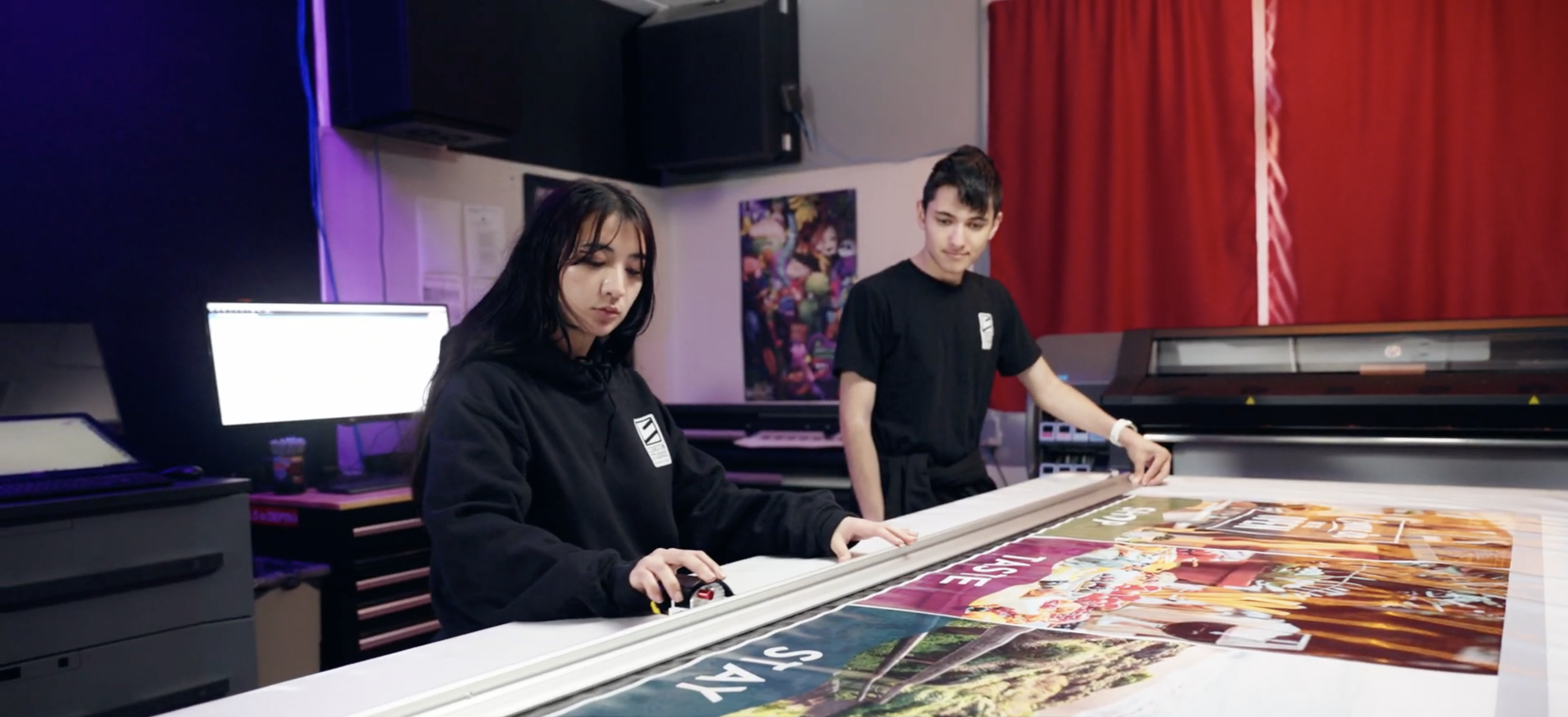
Coastin’ Studios student workers, Carolina Hernandez and Gabby Vargas, assist with a print job.
At Coast Union High School, learning doesn’t stop at textbooks and lectures. Inside the campus’ Coastin’ Studios Printshop, students step into a professional environment where creativity, accountability, and entrepreneurship intersect.
The printshop operates as a student-run enterprise, meaning students manage real client orders, operate professional printing equipment, and help keep the shop running as a functioning business. As part of Coastin’ Studios—the school’s student production team and media arts program—students gain experience designing and producing materials for customers while learning the technology and workflows used across the modern printing industry.
For the students who work there, the experience feels very different from a traditional classroom.
Carolina Hernandez, a student worker in the printshop, says the responsibilities mirror those of a professional workplace.
“When working at the print shop compared to being in a classroom, the stakes are a little higher,” Hernandez said. “In a classroom, if I don’t complete my task or maybe don’t put the most effort on an assignment, I get a bad grade. It only affects me. Compared to working at the print shop, if I don’t complete a task or maybe do a poor job, it affects the customer, which leads to maybe them being unsatisfied.”
That level of accountability is part of what educators call work-based learning—an approach that allows students to gain hands-on experience in real workplace settings while they are still in school. At the Coastin’ Studios Printshop, that means balancing the demands of school with the expectations of real clients.
Hernandez says the opportunity offers more than just classroom credit.
“The best part about working at the print shop is I get work experience, I get college credit, the opportunity to still play sports, and a paycheck every month—and that prepares me for the real world.”
Students in the program operate the shop as both a learning environment and a functioning business. That means managing equipment, fulfilling orders, and understanding what it takes to stay profitable.
Keith Cota Fernandezvar, another student worker, says that balance between education and business sets the program apart.
“Working at the print shop is more than just being in a class,” Fernandez said. “At the same time, it’s still a business. We have to be profitable.”
Fernandez says the program’s instructors guide students through both the technical and professional aspects of the work.
“My supervisor is technically my teacher, but at the same time teaches me how to use the machines and really does a big job being a teacher but also being a boss,” he said. “And yeah, we do make mistakes, but we learn from them so we can be profitable.”
Students also gain exposure to the broader printing industry through conferences and networking opportunities, where they explore new technologies and learn directly from professionals in the field.
“I was really hands-on and they showed me a lot of new things like embroidery machines and heat presses,” Fernandez said of a recent industry conference. “You can’t really learn these types of things during a classroom environment.”
Those experiences give students insight into how the industry is evolving and bring new ideas back to the shop.
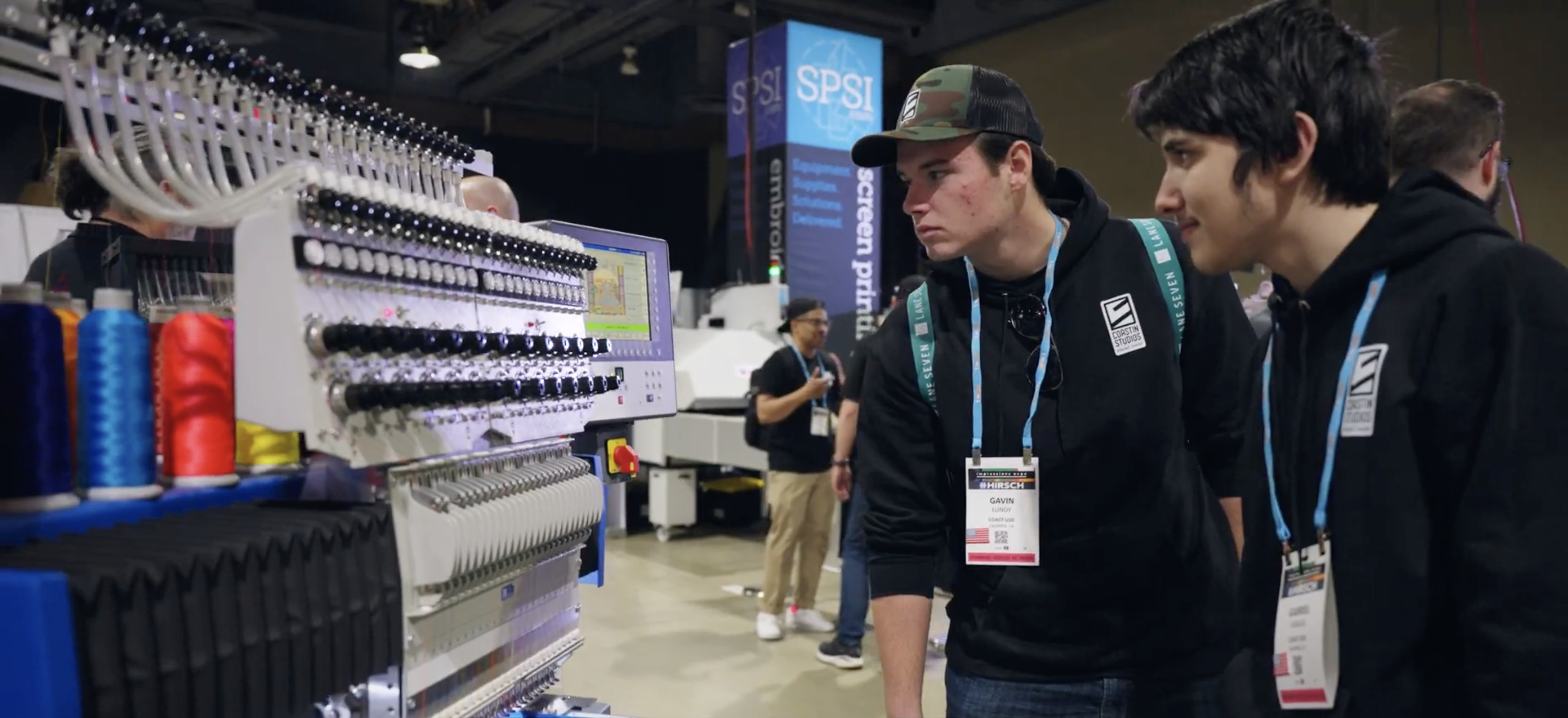
Two Coastin’ Studios student workers examine new technologies at a recent industry conference.
Gabby Vargas, another member of the student team, said conferences allow students to learn directly from professionals.
“We go to conferences to talk to professionals in the printing industry to get tips and strategies that we could bring back to the print shop,” Vargas said.
Inside the shop, students collaborate while learning to operate specialized equipment and production software.
Gabriela Espinoza says the hands-on environment makes the learning experience unique.
“You get hands-on learning on real client orders,” Espinoza said. “And if you make mistakes, it has an effect on the business. There’s a very supportive environment where the full-time staff always are there to explain how different machines work.”
Programs like Coastin’ Studios are part of a growing effort across the Central Coast to connect education with real-world workforce skills.
Sabas Melgar, a first-generation college student now studying computer engineering at California Polytechnic State University, says hands-on learning opportunities like student enterprises can have a lasting impact.
“Working in our student enterprise print shop gave me paid, hands-on experience with industrial equipment and complex design software,” Melgar said. “It allowed me to build my confidence by earning certifications.”
Melgar credits those early experiences with helping him succeed in college engineering.
“Those experiences gave me real-world, employable skills that prepared me for college-level engineering and beyond,” he said. “And now I’m learning by doing at Cal Poly San Luis Obispo.”
Educators say programs like the Coastin’ Studios Printshop are emerging as a regional model for career education—demonstrating how high schools can integrate creative arts, technical training, and real business operations into a single program.
At Coast Union, the printshop continues to serve as both classroom and workplace—where students not only learn creative and technical skills, but also discover what it means to deliver for real customers.
For many students, that combination of creativity, responsibility, and opportunity makes Coastin’ Studios more than just a class. It’s a launchpad for the future.
To learn more, visit the Coast Union High School webpage.
Central Coast K-16 Career Journeys Playlist:
Central Coast K-16 Career Journeys: Oceano Family STEAM Night