




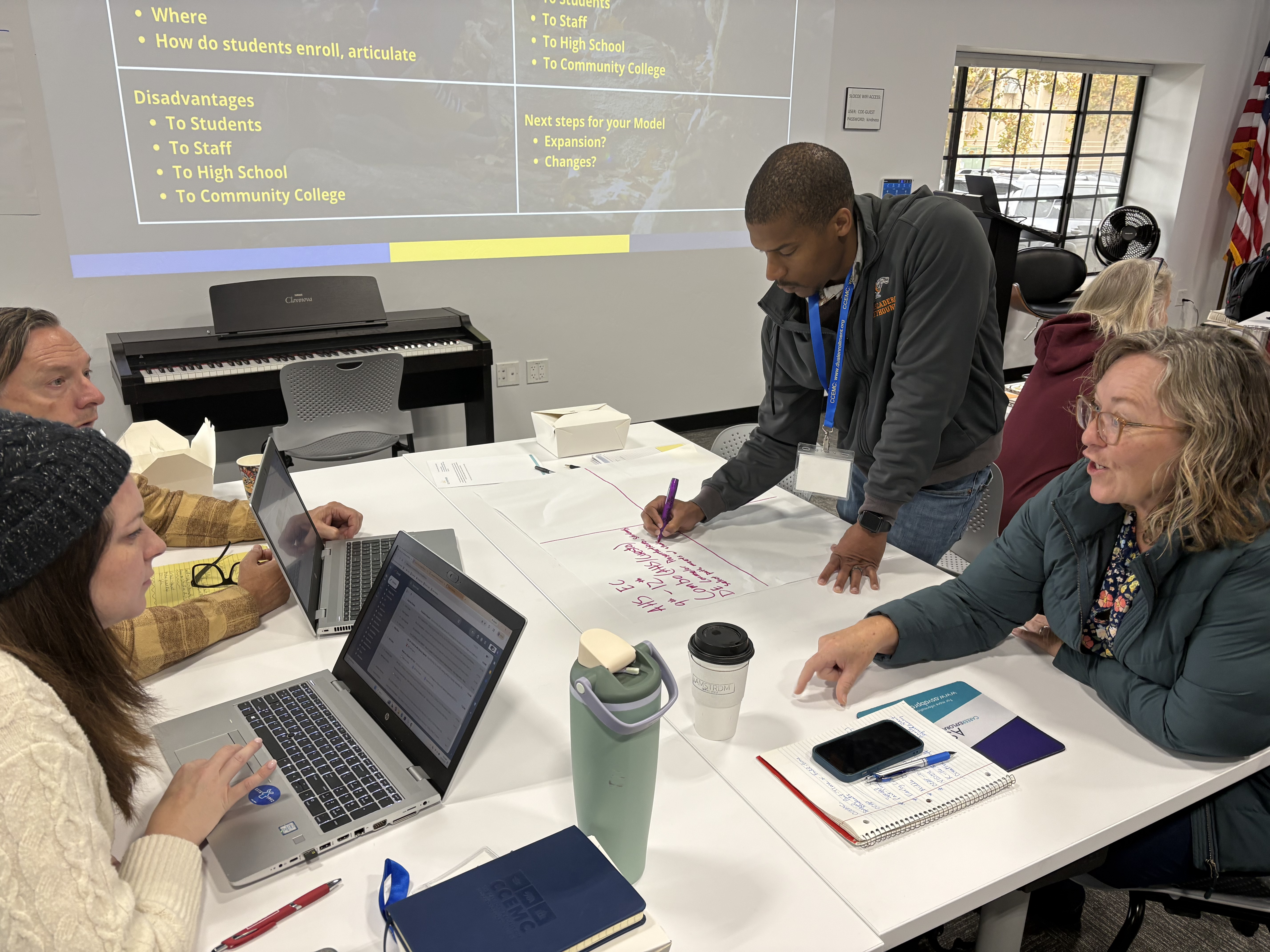
Dual Enrollment Leadership Academy participants in a breakout group
Nearly 25 percent of San Luis Obispo County high school students earn college credit before graduating, placing the county among state leaders in dual enrollment participation. These early college experiences not only reduce the cost of higher education for families, but also accelerate students’ progress toward meaningful college and career pathways.
“Students with early college experiences are more successful, persistent, and resilient graduates through college and career,” said Michael Specchierla, Executive Director of Career & College Pathways at the San Luis Obispo County Office of Education (SLOCOE). “Families and students save money and jumpstart their college and career path to opportunity and success. SLOCOE is proud to lead and support school districts in developing career and college pathways.”
Building on this momentum, the 2025 Dual Enrollment Leadership Academy (DELA) convened a committed cohort of high school and college leaders from across San Luis Obispo County for full-day workshops on October 17 and November 14, hosted by Paso Robles Joint Unified School District, and on December 12, hosted by Lucia Mar Unified School District. The sessions featured reflective testimonials from participants highlighting the academy’s impact on students, families, and local systems. Developed by the California Coalition of Early and Middle Colleges (CCEMC), DELA is designed to strengthen countywide dual enrollment systems by centering equity, collaboration, and intentional pathway design.
At its core, DELA focused on closing opportunity gaps—particularly for first-generation college students and families who may not traditionally see college as attainable. Through expert-led learning, peer collaboration, and structured reflection, participants examined policy, funding, and instructional practices while building shared understanding across districts and Cuesta College. Participants also had the option to earn certification as dual enrollment leaders through sustained engagement and portfolio development.
Strengthening Systems Through Collaboration
A defining feature of the 2025 academy was the emphasis on moving from isolated programs to aligned, countywide systems. Participants repeatedly highlighted the value of being in the same room—district leaders, counselors, teachers, and community college partners—working toward shared goals.
Jennifer Clayton, Director of Student Relations at SLO Partners, SLOCOE, reflected on this shift during the December 12 session:
“Before, it felt a little more siloed—districts were planning and working on their own,” Clayton shared. “Now, all of the districts are at the table together, including the community college. It’s an amazing opportunity to see the leadership of all the districts and Cuesta College here creating programs that are going to benefit students throughout the county.”
For many leaders, DELA also reframed who dual enrollment is for. Josh Aston, Director of Secondary Curriculum at Atascadero Unified School District, described a significant shift in perspective:
“I used to think that dual enrollment was for students who were four-year college bound, and that’s not necessarily the case,” Aston explained. “Since being involved in the Dual Enrollment Leadership Academy, we’ve learned that dual enrollment really is for every student. Any student can benefit from taking a dual enrollment course while they’re in high school… it makes them more marketable whether they go on to college or directly into industry.”
Expanding Access and Student Confidence
Across districts, participants emphasized that dual enrollment is as much about mindset as it is about credits. By embedding college courses within the familiar environment of high school campuses, students are able to experience college-level rigor with the support of trusted teachers and counselors.
Krista Herrera, Assistant Superintendent of Curriculum and Instruction at Santa Maria Joint Union High School District and Dual Enrollment Coach for CCEMC, emphasized the confidence-building nature of dual enrollment:
“When we’re able to embed these classes into our high school system, we’re able to wrap around students with teachers and support in buildings they know,” Herrera said. “Our goal is to eliminate the fear and anxiety of the college experience, help students recognize themselves as college students, and provide that opportunity to as many students as possible.”
Crystal Martinez, College and Career Paths Counselor and Dual Enrollment Coordinator at Coast Union High School, highlighted how dual enrollment helps students envision new possibilities:
“By having students participate in dual enrollment, they’re able to see what life might actually be like in college and start to envision themselves in spaces that they might not otherwise see themselves in,” Martinez shared. “A lot of our students are first-generation, and dual enrollment helps them see that college is something they can be successful in.”
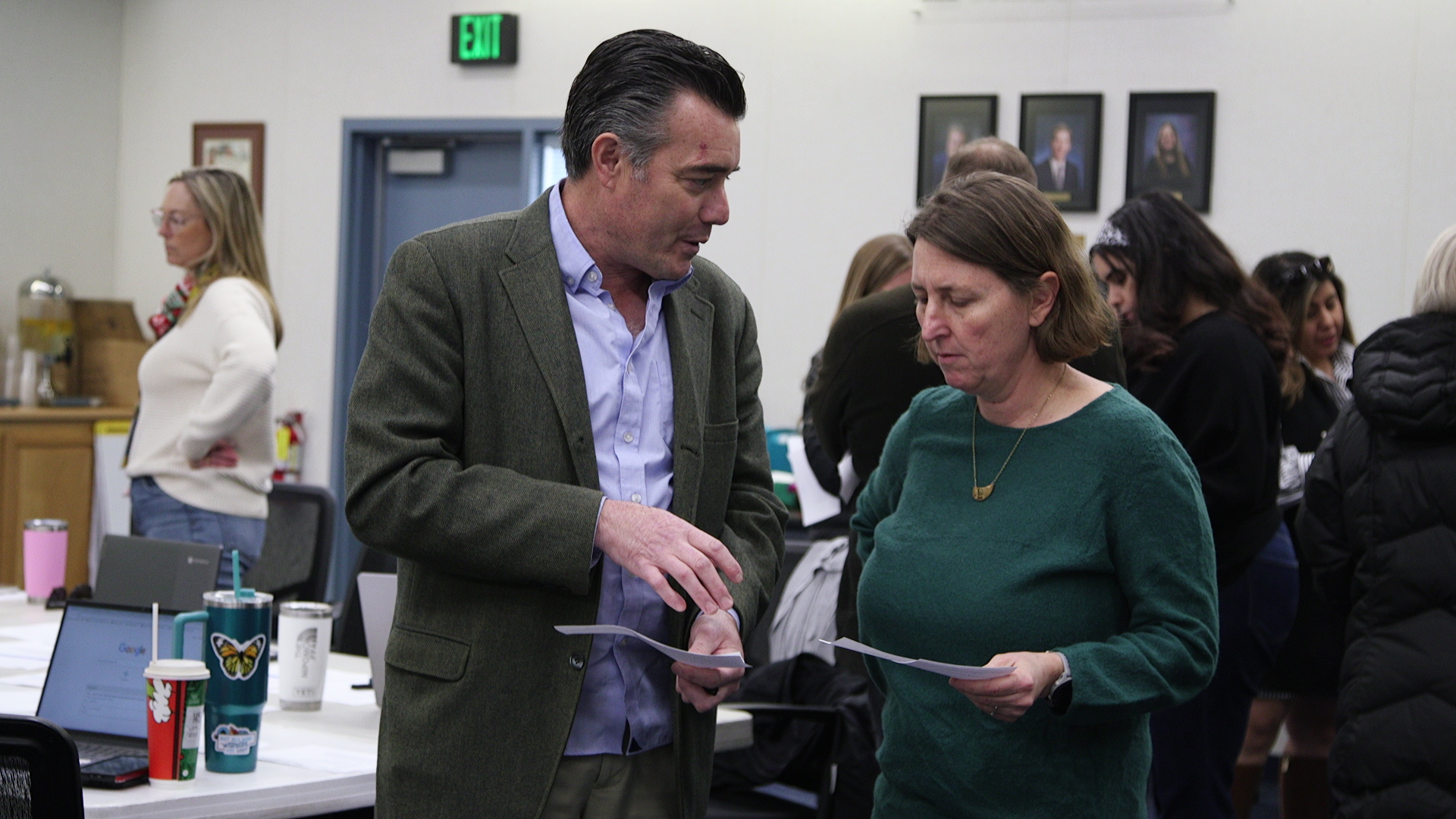
SLOCOE’s Michael Specchierla and PRJUSD’s Megan Cannon discuss dual enrollment implementation strategies
Impact Across the County
Cuesta College continues to serve as a central partner in expanding and sustaining dual enrollment throughout San Luis Obispo County. In the 2024–2025 academic year, more than 4,000 high school students participated in dual enrollment, accounting for approximately 6,000 enrollments countywide. This work includes expanding access to historically underserved populations, such as students at the San Luis Obispo County Juvenile Court School.
Districts across the county are leveraging DELA learning to strengthen and formalize their local programs. Atascadero Unified School District, for example, is using academy insights to help guide the development of its Early College High School program. Paso Robles Joint Unified School District is applying lessons from DELA to move from a broad but loosely organized set of offerings toward more clearly structured pathways that help students and families maximize the benefits of dual enrollment.
Christine Ready, Agriculture Teacher and Dual Enrollment Coordinator at Lucia Mar Unified School District, underscored the importance of intentional pathway design:
“Over the course of the academy, my thinking has changed around the need for a real system,” Ready said. “Making sure our students aren’t just accessing a dual enrollment course here and there, but really accessing a program that’s going to serve them after they graduate—that’s been a big shift.”
Learning with Purpose
Participants consistently praised the academy’s facilitation, relevance, and depth during the sessions, which created space for candid reflection on growth, challenges, and next steps. DELA sessions balanced dense policy and compliance topics with practical application, allowing teams to return to their districts with actionable next steps.
Andrea Kittelson of Paso Robles Joint Unified School District praised the academy’s facilitation:
“Our experience in the DELA Academy with Dr. Krista and Dr. Nick has been an immense pleasure,” Kittelson shared. “Their creative approach to helping us successfully acquire rigorous—and dense—content knowledge has been both inspiring and fruitful. I feel ready to tackle the challenges that come.” The academy created space not only for learning, but for honest dialogue about barriers, opportunities, and shared responsibility.
A Strong Foundation for Future Student Success
Throughout the three-session academy, participants explored high-leverage practices in pathway development, student support, funding, and inter-institutional alignment—all grounded in DELA’s mission to broaden access and improve equitable outcomes. The cohort concluded the academy with stronger partnerships, clearer strategies, and renewed confidence in their ability to expand dual enrollment opportunities for students across San Luis Obispo County.
As districts and colleges continue to work together to help students earn college credit while in high school, the Dual Enrollment Leadership Academy stands as a critical catalyst—empowering educators with the shared vision, expertise, and collaboration needed to help every student see college as possible and attainable.
Congratulations to the 2025 DELA cohort for their leadership, commitment, and dedication to building stronger pathways for all students.
For more on this story, explore video interviews with some of the DELA participants:
Josh Astin (Atascadero Unified School District)
Crystal Martinez (Coast Union High School)
Heidi Webber (Cuesta College)
Christine Ready (Nipomo High School)
Megan Cannon (Paso Robles Joint Unified School District)
Jennifer Clayton (San Luis Obispo County Office of Education)
Victoria Lopez (Santa Maria Joint Union High School District)
Krista Herrera (Santa Maria Joint Union High School District)